

About this chapter
This chapter is about turning a trigonometric equation into one you can solve. That usually means one of two identities, the tan identity or sin²x + cos²x = 1, followed by a quadratic in a single function and then every solution in the interval. The June 2023 and June 2024 examiners found the identities themselves were rarely the problem; the algebra and the full set of solutions were.
The questions cover exact values from one ratio, basic equations in degrees and radians, transformed arguments such as 2x − 30°, proving identities, and quadratics in sin x, cos x or tan x. One question asks you to find the error in a student's working, and the last links an area of a triangle to an equation with a shifted angle.
The ten questions
- Q1 (4 marks): exact values of cos θ and tan θ from sin θ = √5/3 with θ obtuse.
- Q2 (5 marks): solve 4 sin x = 3 and 3 tan x + 5 = 0 for 0 ≤ x < 360°.
- Q3 (4 marks): solve 2 sin(x − π/6) = √3 in radians, as exact multiples of π.
- Q4 (6 marks): prove an identity using the difference of two squares, then solve an equation with it.
- Q5 (4 marks): solve tan(2x − 30°) = √3 for 0 ≤ x < 180°, adjusting the interval first.
- Q6 (8 marks): 3 tan x sin x = 8 becomes a quadratic in cos x, then the same equation in 2θ.
- Q7 (8 marks): find the error in a student's working that divides by sin x, then solve correctly.
- Q8 (8 marks): a quadratic in sin x solved in radians, with an impossible value rejected, then a count of solutions over a longer interval.
- Q9 (9 marks): an equation in sin², sin cos and cos² becomes a quadratic in tan x, then an exact value of sin x.
- Q10 (10 marks): a triangle's area gives sin θ = 3/5, two values of cos θ and two exact sides, then an equation in x − 20°.
Key skills tested
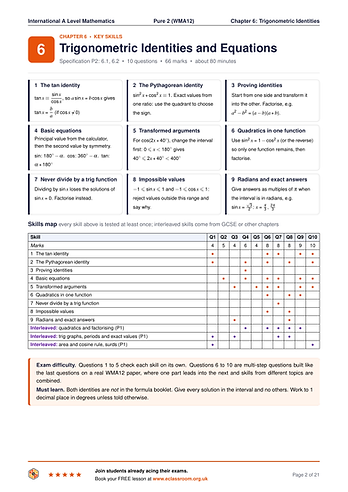
The tan identity. tan x = sin x ÷ cos x, so a sin x = b cos x becomes tan x = b/a, provided cos x is not zero.
The Pythagorean identity. sin²x + cos²x = 1. To find exact values from one ratio, use the quadrant to choose each sign.
Proving identities. Start from one side and transform it into the other, factorising where you can, for example with a² − b² = (a−b)(a+b).
Basic equations. Take the principal value from the calculator, then find the second value by symmetry: 180° minus it for sin, 360° minus it for cos, and 180° plus it for tan.
Transformed arguments. Change the interval first. For cos(2x + 40°) with 0 ≤ x < 180°, the angle 2x + 40° runs from 40° to 400°.
Quadratics in one function. Use sin²x = 1 − cos²x, or the reverse, so only one function remains, then factorise.
Never divide by a trig function. Dividing by sin x throws away the solutions of sin x = 0. Factorise instead.
Impossible values. Sin and cos always lie between −1 and 1, so reject any value outside that range and say why.
Radians and exact answers. When the interval is in radians, give answers as multiples of π. For example, sin x = √3/2 gives x = π/3 or 2π/3.
Worked example
Question 2 from this chapter. Solve, for 0 ≤ x < 360°, (a) 4 sin x = 3 and (b) 3 tan x + 5 = 0, giving answers to one decimal place.
(a) sin x = 0.75, so the principal value is 48.6°. Sin is also positive in the second quadrant, giving 180° − 48.6° = 131.4°. So x = 48.6° or 131.4°.
(b) tan x = −5/3, so the calculator gives −59.0°, which is outside the interval. Tan repeats every 180°, so add 180° to get 121.0°, and again to get 301.0°. So x = 121.0° or 301.0°.
Always check that every answer lies in the interval and that none is missing.

Seen on real papers
Every question in our booklets is original. These are the recent papers where each question type has appeared.
- June 2024, Q8(i): an equation with tan x turned into a quadratic in cos x, solved in radians, as in Q6.
- June 2023, Q9: both identities used to reach a quadratic, then an equation in cos 2x with four solutions, as in Q6(c) and Q5.
- June 2024, Q8(ii): a sine function of a shifted angle in context, where the angle must not be split into two sines, like the equation in Q10(e).
Where marks are lost
- Not multiplying every term. In June 2024 many multiplied through by cos x but missed the constant term, and never reached a three-term quadratic.
- Sin with no angle. Writing sin or cos without the x or θ after it cost the final mark in June 2023, and was still common in June 2024.
- Working in degrees. In June 2024 numerous students solved in degrees although the interval was in radians.
- The doubled angle. In June 2023, after solving for cos 2x, many forgot to divide by 2, or stopped at two solutions when the range for 2x went up to 720° and needed four.
Common questions
Are the tan and Pythagorean identities in the formula booklet?
No. Both have to be learned for Pure 2.
Why can I not divide by sin x?
If sin x = 0 at any solution, dividing by it removes those solutions. Factorise out sin x instead, and solve both factors.
How many solutions should I expect?
Sketch the graph over the interval, or list the angles by symmetry, and count before you stop.
Where this chapter leads
- Pure 3 Chapter 3: Trigonometric Functions: sec, cosec and cot, and more identities.
- Pure 3 Chapter 4: Trigonometric Addition Formulae: double-angle formulae and the R form.