

About this chapter
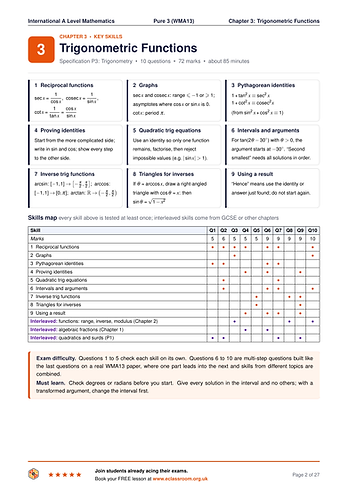
Trigonometric functions adds three new functions, sec, cosec and cot, two new identities, and the inverse trig functions arcsin, arccos and arctan. Most questions ask you to prove an identity and then use it, so the key habit is to reach for the earlier result rather than starting again.
This chapter covers the reciprocal functions and their graphs, the identities 1 + tan²x = sec²x and 1 + cot²x = cosec²x, proving identities, quadratic trig equations, transformed arguments and the second smallest solution, and the inverse functions with their domains and ranges.
The ten questions
- Q1 (5 marks): exact tan θ and cosec θ from sec θ = −3 with θ obtuse.
- Q2 (6 marks): an equation in cosec²x and cot x becomes a quadratic in cot x, solved in radians.
- Q3 (5 marks): sketch y = sec x with asymptotes and turning points, then the range of 3 − 2 sec x.
- Q4 (5 marks): prove sec x − cos x = sin x tan x, then a second identity from it.
- Q5 (5 marks): sketch y = arccos x, solve an equation, and show sin(arccos x) = √(1 − x²).
- Q6 (9 marks): prove an identity, use it to solve an equation in 2x as exact multiples of π, and explain why another equation has no solutions.
- Q7 (9 marks): 3 sec²x − 5 tan x − 5 = 0 as a quadratic in tan x, then the second smallest positive solution of a transformed version.
- Q8 (9 marks): sketch arctan x, then the range and inverse of π/4 + arctan 2x.
- Q9 (9 marks): show arcsin x + arccos x = π/2, solve an equation with both, and an exact tangent value.
- Q10 (10 marks): the graph and range of 2 + cosec x, an equation, and when f(x) = k has no solutions.
Key skills tested
Reciprocal functions. sec x = 1/cos x, cosec x = 1/sin x, and cot x = 1/tan x = cos x ÷ sin x.
Graphs. sec x and cosec x never lie between −1 and 1, with asymptotes where cos x or sin x is zero. cot x has period π.
Pythagorean identities. 1 + tan²x = sec²x and 1 + cot²x = cosec²x, both from sin²x + cos²x = 1.
Proving identities. Start from the more complicated side, write it in sin and cos, and show every step to the other side.
Quadratic trig equations. Use an identity so only one function remains, factorise, then reject impossible values.
Intervals and arguments. For tan(2θ − 30°) with θ positive, the argument starts at −30°. The second smallest solution needs all the solutions listed in order.
Inverse trig functions. arcsin gives values from −π/2 to π/2, arccos from 0 to π, and arctan between −π/2 and π/2.
Triangles for inverses. If θ = arccos x, draw a right-angled triangle with cos θ = x. Then sin θ = √(1 − x²).
Using a result. "Hence" means use the identity or answer just found, not start again.
Worked example
Question 1 from this chapter. Given that sec θ = −3 and θ is obtuse, find the exact value of (a) tan θ and (b) cosec θ, in the form a√2.
(a) tan²θ = sec²θ − 1 = 9 − 1 = 8, so tan θ = ±2√2. An obtuse angle has a negative tangent, so tan θ = −2√2.
(b) cos θ = −1/3, so sin θ = √(1 − 1/9) = 2√2/3, which is positive for an obtuse angle. Then cosec θ = 3/(2√2) = 3√2/4.
The sign in each part comes from the quadrant, and the question warns that calculator solutions are not acceptable.

Seen on real papers
Every question in our booklets is original. These are the recent papers where each question type has appeared.
- June 2024, Q4(c)(ii): a "second smallest" solution, where most answers found only the smallest, as in Q7(c).
- June 2024, Q9(b): x written as a trig function of y, with identities used to express the derivative in terms of x, which builds on the triangle method in Q5 and Q9.
Where marks are lost
- Ignoring "second smallest". In June 2024 the phrase threw many students, who gave the smallest solution and scored nothing for the part. List the solutions in order first.
- Working towards the answer. The June 2024 examiners saw students steering towards a printed result with incorrect identities. Use only valid identities, even if the target is not reached.
- Square roots over fractions. Writing a square root that does not cover the whole fraction was a notation error the examiners singled out.
- Forgetting the sign. After squaring, both signs appear. Choose the one that matches the quadrant.
Common questions
Where do the new identities come from?
Divide sin²x + cos²x = 1 by cos²x to get 1 + tan²x = sec²x, or by sin²x to get 1 + cot²x = cosec²x.
What range does arccos give?
From 0 to π, so arccos never gives a negative angle.
Degrees or radians?
Check the interval before you start. Both appear, and mixing them is a common way to lose every accuracy mark.
Where this chapter leads
- Pure 3 Chapter 4: Trigonometric Addition Formulae: double-angle formulae and R forms.
- Pure 3 Chapter 6: Differentiation: differentiating sec, cosec and cot, and x as a function of y.