

About this chapter
Trigonometric addition formulae gives Pure 3 its most powerful trig tools: the addition and double-angle formulae and the R form, which turns a sin x + b cos x into a single wave. The June 2024 WMA13 paper used both, asking for an R form, its maximum, and a second smallest solution, then a compound-angle identity followed by an equation that depended on it.
This chapter covers the addition formulae, exact values from split angles, double-angle identities, proofs, equations, R forms, maxima and minima of related expressions, solving with R forms, and a harbour depth model answered as clock times.
The ten questions
- Q1 (5 marks): show sin 75° = (√6 + √2)/4, then an exact sin(A − B) from two tangents.
- Q2 (5 marks): 2 cos 2x + 5 sin x = 3 as a quadratic in sin x, in degrees.
- Q3 (5 marks): 5 sin x − 12 cos x as R sin(x − α), then its maximum and where it occurs.
- Q4 (5 marks): prove (1 − cos 2θ)/sin 2θ = tan θ, then find tan 15° exactly.
- Q5 (5 marks): solve tan(x − π/4) = 6 tan x with the addition formula.
- Q6 (10 marks): an R cos form, the maximum of 12/(10 + f(x)) and where it happens, and an equation in radians.
- Q7 (10 marks): derive the triple-angle identity for cos 3x, solve an equation with it, and an exact cos 3α.
- Q8 (10 marks): an R form models the depth of water in a harbour: its maximum and the times it reaches 12 m.
- Q9 (10 marks): prove cosec 2x + cot 2x = cot x, use it to solve an equation, then cot(π/8) exactly.
- Q10 (10 marks): √3 cos x + sin x as R cos(x − α), an equation in 2x, and when a horizontal line meets the curve twice.
Key skills tested
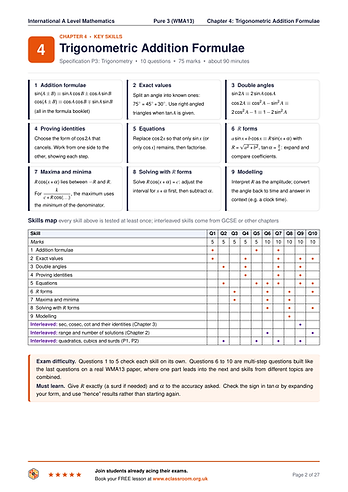
Addition formulae. sin(A ± B) = sin A cos B ± cos A sin B, and cos(A + B) = cos A cos B − sin A sin B, with the sign flipped for cos(A − B). Both are in the formula booklet.
Exact values. Split an angle into known ones, such as 75° = 45° + 30°, and use right-angled triangles when a tangent is given.
Double angles. sin 2A = 2 sin A cos A, and cos 2A = cos²A − sin²A = 2 cos²A − 1 = 1 − 2 sin²A.
Proving identities. Choose the form of cos 2A that makes things cancel, and work from one side to the other.
Equations. Replace cos 2x so that only sin x, or only cos x, remains, then factorise.
R forms. a sin x + b cos x = R sin(x + α), with R = √(a² + b²) and tan α = b/a. Expand and compare coefficients to be sure of the signs.
Maxima and minima. R cos(x + α) lies between −R and R. For a fraction with an R form in the denominator, the maximum comes from the denominator's minimum.
Solving with R forms. Adjust the interval for x + α first, solve, then subtract α.
Modelling. R is the amplitude. Convert the angle back to time and answer in context, such as a clock time.
Worked example
Question 3 from this chapter. (a) Express 5 sin x − 12 cos x in the form R sin(x − α), where R is positive and α is between 0 and 90°. (b) Write down the maximum value, and find where it occurs for 0 ≤ x < 360°.
(a) R = √(5² + 12²) = 13. Expanding, R sin(x − α) = R sin x cos α − R cos x sin α, so R cos α = 5 and R sin α = 12, giving tan α = 12/5 and α = 67.38°. So 5 sin x − 12 cos x = 13 sin(x − 67.38°).
(b) The maximum is 13, when x − 67.38° = 90°, so x = 157.38°.
Expanding the R form, rather than guessing the sign of α, is what keeps the answer right.

Seen on real papers
Every question in our booklets is original. These are the recent papers where each question type has appeared.
- June 2024, Q4: a double-angle identity, an R form with an exact R, its maximum, and a second smallest solution, as in Q3, Q6 and Q10.
- June 2024, Q7: a compound-angle identity proved first, then used to solve a harder equation, as in Q5 and Q9.
Where marks are lost
- R not exact. In June 2024 some gave R as a decimal and lost the mark. Leave it as a surd, such as 2√5.
- Not writing the R form out. A significant number found R and α but never wrote the expression, which the final mark needed.
- Starting again. In the June 2024 equation, many did not see how to use the identity just proved, and began again with long, error-prone working.
- A wrong cos 2x. Several wrote down an incorrect version of the cos 2x identity, so learn all three forms exactly.
Common questions
Are the addition formulae in the formula booklet?
Yes, the compound-angle formulae are given. The double-angle forms follow from them, so it is quicker to know them.
How do I find α without a sign error?
Expand your chosen R form and compare the coefficients of sin x and cos x before finding tan α.
Why does a question use "hence" after a proof?
Because the identity is the quickest route to the answer. Substituting into it avoids pages of working.
Where this chapter leads
- Pure 3 Chapter 7: Integration: double-angle identities used to integrate sin²x and cos²x.
- Pure 4 Chapter 3: Coordinate Geometry: trig identities used to turn parametric equations into Cartesian ones.