

About this chapter
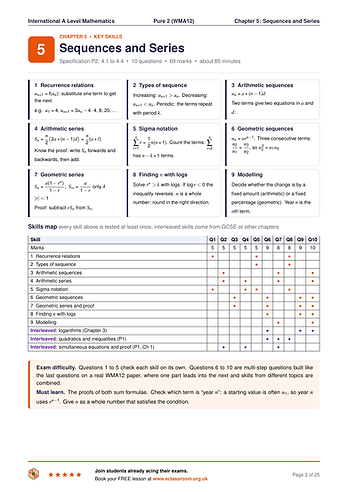
Sequences and series is where Pure 2 turns into real-world modelling: bottles recycled each month, salaries rising by a fixed amount or a fixed percentage. The formulae are in the booklet, so the marks depend on setting the problem up correctly, especially deciding which term is year n and rounding the number of terms the right way.
The chapter covers recurrence relations and periodic sequences, arithmetic and geometric sequences and series, sigma notation, sums to infinity, the proofs of both sum formulae, and using logarithms to find how many terms are needed. The final questions set up a geometric sequence from three algebraic terms and compare two salary schemes over ten years.
The ten questions
- Q1 (5 marks): terms of a recurrence relation in terms of k, a condition to find k, then a sum.
- Q2 (5 marks): an arithmetic sequence from its 4th and 10th terms, then the sum of 20 terms.
- Q3 (5 marks): a geometric series with ratio 2/3: a term, a sum, the sum to infinity and the gap between them.
- Q4 (5 marks): prove the arithmetic series formula, then use it on a sum in sigma notation.
- Q5 (5 marks): a recurrence relation that repeats every three terms, and the sum of 100 terms.
- Q6 (9 marks): three algebraic terms form a geometric sequence: two values of k, a sum to infinity, and the least n with a sum over 1000.
- Q7 (8 marks): recycled bottles as an arithmetic sequence from the 6th term and a 10-month total, then the first month the total passes 10 000.
- Q8 (8 marks): a recurrence with a constant a: three terms summing to 21 give a quadratic, and an increasing sequence picks the value.
- Q9 (9 marks): prove the geometric series formula, find r and a from two conditions, then the least n for a close match to the sum to infinity.
- Q10 (10 marks): two salary schemes, one rising by a fixed amount and one by a percentage, compared year by year and in total.
Key skills tested
Recurrence relations. Substitute one term to get the next. For example, starting at 4 and multiplying by 3 then subtracting 4 gives 4, 8, 20 and so on.
Types of sequence. Increasing, decreasing, or periodic, where the terms repeat with a fixed period.
Arithmetic sequences. The nth term is a + (n−1)d, so two known terms give two equations in a and d.
Arithmetic series. The sum of n terms is n/2 times (2a + (n−1)d), or n/2 times the first plus the last. Learn the proof: write the sum forwards and backwards, then add.
Sigma notation. The sum of r from 1 to n is ½n(n+1). A sum from r = k to r = n has n − k + 1 terms.
Geometric sequences. Each term is the previous one times r. For three consecutive terms, the middle one squared equals the product of the other two.
Geometric series. The sum to infinity is a/(1 − r), and it exists only when r is between −1 and 1. To prove the sum formula, subtract r times the sum from the sum.
Finding n with logs. Solve the inequality with logs, remembering that dividing by the log of a number below 1 reverses the sign. Then round n in the right direction.
Modelling. Decide whether the change is a fixed amount (arithmetic) or a fixed percentage (geometric), and whether year n is the nth term.
Worked example
Question 2 from this chapter. The 4th term of an arithmetic sequence is 23 and the 10th term is 53. (a) Find the first term and common difference. (b) Find the sum of the first 20 terms.
(a) The two terms give a + 3d = 23 and a + 9d = 53. Subtracting, 6d = 30, so d = 5, and then a = 23 − 15 = 8.
(b) Using the sum formula with n = 20: 20/2 × (2 × 8 + 19 × 5) = 10 × (16 + 95) = 1110.
Writing both equations before solving earns the method mark even if an arithmetic slip follows.

Seen on real papers
Every question in our booklets is original. These are the recent papers where each question type has appeared.
- June 2024, Q2: an arithmetic sequence from its 6th term and the sum of 10 terms, then the least number of terms for a total, as in Q7.
- June 2024, Q10: growth by a fixed percentage each year, where choosing the right power for year n decided the marks, as in Q10.
- June 2023, Q6: a geometric model given in thousands, solved for n with logarithms, as in Q6(d) and Q9(c).
- June 2023, Q11: a recurrence relation whose first three terms add to a total, leading to a quadratic, as in Q8.
Where marks are lost
- Not rounding n up. In June 2024 a surprising number found the right root for n but left it as a decimal or rounded it down.
- Which power for year n? Using the power for the wrong year was the most common error on the June 2024 percentage question. If the first year is the starting value, year n uses the power n − 1.
- Forgetting the units. In June 2023, answers in a model measured in thousands were often given without converting.
- Mixing up pairs of values. In June 2023 some students combined the wrong a with the wrong b, or kept a second solution that the condition ruled out.
Common questions
Do I need to know the proofs of the sum formulae?
Yes. Both the arithmetic and geometric proofs can be asked for directly, as in Q4 and Q9.
When does a geometric series have a sum to infinity?
Only when the common ratio is between −1 and 1, so that the terms shrink towards zero.
Can I find n by trial and improvement?
The June 2024 examiners discouraged it. Form the inequality and solve it with the sum formula or logs, then round.
Where this chapter leads
- Pure 3 Chapter 8: Numerical Methods: iteration, where a recurrence relation homes in on a root.
- Pure 4 Chapter 4: Binomial Expansion: infinite series and when they converge.