

About this chapter
Partial fractions splits a complicated fraction into simple ones, and in Pure 4 that split is almost never the end of the question. It is the first step before a binomial expansion, an integration, a derivative or a series that telescopes, so a wrong constant costs marks in every later part.
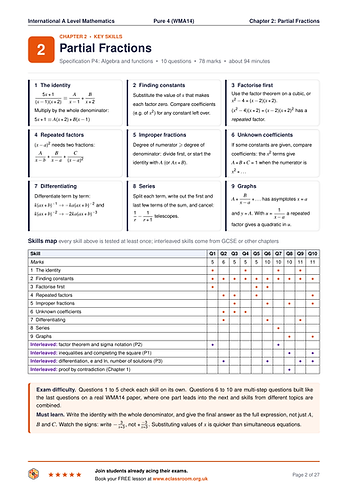
This chapter covers writing the identity, finding constants by substitution and by comparing coefficients, factorising the denominator first, repeated factors, improper fractions, unknown coefficients, and using partial fractions to differentiate, sum a series, and study the asymptotes and turning points of a curve.
The ten questions
- Q1 (5 marks): factorise a cubic denominator with the factor theorem, then split into three fractions.
- Q2 (6 marks): a repeated factor (3t − 1)² gives three constants, then f′(0) from the split form.
- Q3 (5 marks): an improper fraction written as 2 plus a proper one, then split with a repeated factor.
- Q4 (5 marks): given two of the constants, find B and the unknowns p and q in the numerator.
- Q5 (5 marks): a denominator hiding a repeated factor once x² − 4 is factorised.
- Q6 (10 marks): an improper fraction as Ax + B + C/x + D/(x + 3), its derivative, and why no tangent is parallel to y = 2x + 5.
- Q7 (10 marks): split 2/(r(r+1)(r+2)), sum the series by cancelling, and an exact partial sum.
- Q8 (10 marks): a curve with two vertical asymptotes: the split form, a proof by contradiction, and where f(x) > 3.
- Q9 (11 marks): partial fractions in u, where u is e to the power x, lead to a derivative, a stationary point and an exact maximum.
- Q10 (11 marks): a repeated factor gives a quadratic in u = 1/(x − 1), the minimum point, and a count of solutions.
Key skills tested
The identity. Write the fraction as A/(x − 1) + B/(x + 2), then multiply through by the whole denominator: 5x + 1 = A(x+2) + B(x−1).
Finding constants. Substitute the value of x that makes each factor zero, and compare coefficients, such as those of x², for any constant left over.
Factorise first. Use the factor theorem on a cubic, or spot that (x² − 4)(x + 2) = (x−2)(x+2)², a repeated factor.
Repeated factors. A squared factor (x − a)² needs two fractions: one over (x − a) and one over (x − a)².
Improper fractions. When the numerator's degree is at least the denominator's, divide first, or start the identity with a constant (or a linear term).
Unknown coefficients. If some constants are given, compare coefficients. For a numerator starting with x², the x² terms give A + B + C = 1.
Differentiating. Differentiate term by term: k/(ax + b) gives −ka/(ax + b)², and k/(ax + b)² gives −2ka/(ax + b)³.
Series. Split each term, write out the first and last few terms of the sum, and cancel: 1/r − 1/(r+1) telescopes.
Graphs. A + B/(x − a) + ... has asymptotes x = a and y = A. With u = 1/(x − a), a repeated factor becomes a quadratic in u.
Worked example
Question 1 from this chapter. (a) Show that (x − 1) is a factor of x³ − 2x² − 5x + 6 and factorise it completely. (b) Hence express (4x² + 3x − 25)/(x³ − 2x² − 5x + 6) in partial fractions.
(a) At x = 1: 1 − 2 − 5 + 6 = 0, so (x − 1) is a factor. Dividing leaves x² − x − 6, so the cubic is (x−1)(x+2)(x−3).
(b) Write 4x² + 3x − 25 = A(x+2)(x−3) + B(x−1)(x−3) + C(x−1)(x+2). Putting x = 1 gives −18 = −6A, so A = 3. Putting x = −2 gives −15 = 15B, so B = −1. Putting x = 3 gives 20 = 10C, so C = 2.
So the fraction equals 3/(x−1) − 1/(x+2) + 2/(x−3). The final mark needs this whole expression, not just the three constants.

Seen on real papers
Every question in our booklets is original. These are the recent papers where each question type has appeared.
- January 2024, Q2: partial fractions with a squared factor, then an exact integral written as a single logarithm, as in Q2 and Q5, and as used again in Chapter 6.
Where marks are lost
- Simultaneous equations instead of substitution. In January 2024 the students who expanded and solved simultaneous equations made more errors than those who substituted values of x.
- Multiplying by too much. A few multiplied by the product of all three denominators, giving a cube of the repeated factor.
- Integrating the split form. Many failed to divide the second logarithm by its coefficient of x, and the squared term's integral often had the wrong sign or coefficient.
- Constants but no expression. Giving only A, B and C loses the mark for the full answer.
Common questions
How many fractions does a repeated factor need?
Two: one over the factor and one over its square, as well as one for each other factor.
Substitution or comparing coefficients?
Substitute the values that make each factor zero; it is faster and less error-prone. Compare coefficients only for a constant substitution cannot reach.
What if the fraction is improper?
Divide first, or include a constant term in the identity, before splitting the proper part.
Where this chapter leads
- Pure 4 Chapter 4: Binomial Expansion: each partial fraction expanded as a series.
- Pure 4 Chapter 6: Integration: integrating partial fractions and solving differential equations with them.