

About this chapter
The binomial expansion is one of the most reliable sources of marks in Pure 2, as long as the brackets are right. The June 2023 and June 2024 examiners saw very few problems with the binomial coefficients themselves; nearly every lost mark came from a missing bracket around bx, a dropped negative sign, or the wrong terms combined when two brackets were multiplied.
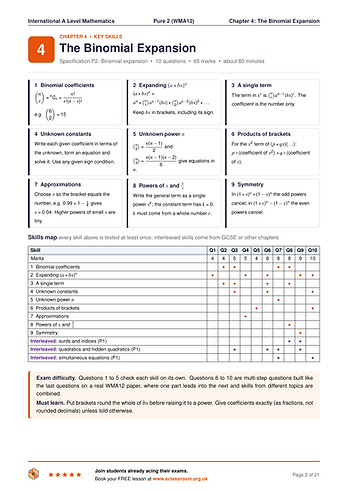
This chapter covers expanding powers of (a + bx), finding a single term, unknown constants and an unknown power n, products of brackets, approximations, expansions with both x and 1/x, and the cancelling that happens when (1 + x) and (1 − x) expansions are added.
The ten questions
- Q1 (4 marks): the first four terms of (2+3x) to the power 5.
- Q2 (4 marks): the coefficients of x³ and x to the power 5 in (3−2x) to the power 7.
- Q3 (5 marks): a given coefficient of x² fixes k in (1+kx) to the power 8, then the x³ coefficient.
- Q4 (5 marks): expand (1 − x/4) to the power 10, then choose x to estimate 0.99 to the power 10.
- Q5 (4 marks): the x² coefficient in (3+x) times (1−2x) to the power 5.
- Q6 (8 marks): expansion of (2+px) to the power 6 with 2D = 15B and p negative: find p, then C, then the last coefficient.
- Q7 (8 marks): given coefficients of x and x² find n and a, then the largest coefficient.
- Q8 (8 marks): the general term of an expansion in x² and 2/x, the constant term, and why there is no x² term.
- Q9 (9 marks): add the expansions of (1+x) and (1−x) to the power 5, evaluate a surd expression, then solve an equation.
- Q10 (10 marks): a product of two brackets with coefficient conditions gives b = a and the value of a, then an exact x³ coefficient.
Key skills tested
Binomial coefficients. nCr counts the ways to choose r from n; your calculator gives it directly. For example, 6C2 = 15.
Expanding a power of (a + bx). Each term takes a falling power of a and a rising power of bx, multiplied by nCr. Keep bx in brackets, including its sign.
A single term. The term in x to the power r is nCr times a to the power (n − r) times (bx) to the power r. The coefficient is the number only.
Unknown constants. Write each given coefficient in terms of the unknown, form an equation and solve it, using any sign condition you are given.
Unknown power n. nC2 = n(n−1)/2 and nC3 = n(n−1)(n−2)/6 give equations in n.
Products of brackets. For the x² term of (p + qx) times an expansion, take p times its x² coefficient plus q times its x coefficient.
Approximations. Choose x so the bracket equals the number. For example, 0.99 = 1 − x/4 when x = 0.04, and higher powers of a small x are tiny.
Powers of x and 1/x. Write the general term as a single power of x. The constant term has power zero, and the power must come from a whole-number r.
Symmetry. Adding the expansions of (1 + x) and (1 − x) to the same power cancels the odd powers; subtracting cancels the even powers.
Worked example
Question 1 from this chapter. Find the first 4 terms, in ascending powers of x, of the binomial expansion of (2+3x) to the power 5.
Term 1: 2 to the power 5 is 32.
Term 2: 5C1 × 2 to the power 4 × (3x) = 5 × 16 × 3x = 240x.
Term 3: 5C2 × 2³ × (3x)² = 10 × 8 × 9x² = 720x².
Term 4: 5C3 × 2² × (3x)³ = 10 × 4 × 27x³ = 1080x³.
So the expansion begins 32 + 240x + 720x² + 1080x³. Squaring and cubing the whole of 3x, not just the x, is what keeps the coefficients right.

Seen on real papers
Every question in our booklets is original. These are the recent papers where each question type has appeared.
- June 2024, Q1: the first four terms of an expansion with a negative fractional term, then a coefficient from a product of two brackets, as in Q1 and Q5.
- June 2023, Q4: an expansion of (3 + px) to the power 5 with two coefficients linked by an equation, a sign condition on p, then a third coefficient, as in Q6.
Where marks are lost
- A lost negative sign. In June 2024, missing the minus sign on the x term was the most common error in the first four terms.
- Brackets around px. In June 2023 many wrote (px)³ as px³, which put the wrong power of p into every later part.
- Combining terms from two brackets. In June 2024 some used only one of the two products needed for a coefficient, or multiplied one term by both.
- Ignoring a given condition. In June 2023 the final mark went when the positive value of p was kept although the question said p was negative.
- Rounding a coefficient. Giving a coefficient as a rounded decimal instead of an exact fraction lost the accuracy mark in June 2024.
Common questions
Is the binomial expansion in the formula booklet?
Yes, the general expansion is given, but you still need to apply it carefully, bracketing the whole of bx.
What exactly is a coefficient?
The number in front of the power of x, without the x. The coefficient of x² in 720x² is 720.
When is an approximation from the expansion accurate?
When x is small, so the terms with higher powers of x become tiny and can be left out.
Where this chapter leads
- Pure 4 Chapter 4: Binomial Expansion: expansions for negative and fractional powers, and when they are valid.
- Pure 2 Chapter 5: Sequences and Series: more work with sums, terms and general formulae.