

About this chapter
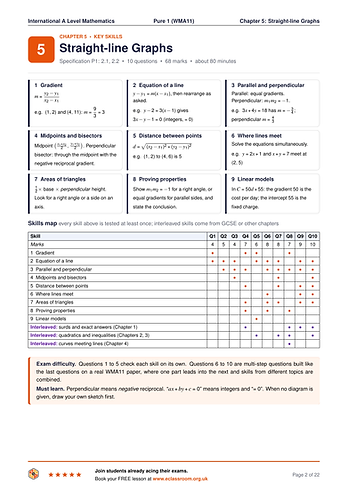
Straight-line graphs opened the October 2024 WMA11 paper, and it looks like easy marks. It is, until the answer has to be in the form ax + by + c = 0 with integers, a perpendicular gradient is needed, or there is no diagram and you have to draw your own.
This chapter covers gradients, equations of lines, parallel and perpendicular lines, midpoints and perpendicular bisectors, distances, and areas of triangles, plus a linear model for hiring costs. The later questions ask you to prove a right angle, find a point from a given area with two possible answers, work with a line that depends on a constant k, and reflect a point in a line.
The ten questions
- Q1 (4 marks): the line through A(−2, 7) and B(4, −2), in the form ax + by + c = 0.
- Q2 (5 marks): the gradient of 2x − 5y + 10 = 0, a perpendicular line through (4, −1), and where it crosses the x-axis.
- Q3 (4 marks): the perpendicular bisector of the line joining (−3, 4) and (5, 8).
- Q4 (7 marks): prove that angle PQR is 90°, then find the fourth vertex and the area of the rectangle PQRS.
- Q5 (6 marks): a linear model for van hire: find the constants, interpret the gradient, and compare with a second company.
- Q6 (8 marks): a line through the origin perpendicular to a given line, where they meet, and a "show that" comparing two triangle areas.
- Q7 (8 marks): a perpendicular bisector, the length AB = 10, then both possible positions of C for a triangle of area 25.
- Q8 (7 marks): the line y = kx meets the curve y = x(6−x), and a perpendicular condition gives k in the form a + b√2.
- Q9 (9 marks): a trapezium built from parallel and perpendicular lines, with the fourth vertex and its exact area.
- Q10 (10 marks): the foot of a perpendicular, a reflection in a line, the distance between a point and its image as a√5, and points giving a triangle of area 15.
Key skills tested
Gradient. Divide the change in y by the change in x. For example, (1, 2) and (4, 11) give a gradient of 9/3 = 3.
Equation of a line. For a line through (a, b), use y − b = m(x − a), then rearrange into the form asked for. For example, y − 2 = 3(x−1) becomes 3x − y − 1 = 0.
Parallel and perpendicular. Parallel lines have equal gradients; perpendicular gradients multiply to −1. For example, 3x + 4y = 18 has gradient −3/4, so a perpendicular line has gradient 4/3.
Midpoints and bisectors. The midpoint averages the coordinates. A perpendicular bisector passes through the midpoint with the negative reciprocal gradient.
Distance between points. Use Pythagoras on the changes in x and y. For example, (1, 2) to (4, 6) is √(9+16) = 5.
Where lines meet. Solve their equations simultaneously. For example, y = 2x + 1 and x + y = 7 meet at (2, 5).
Areas of triangles. Use ½ × base × perpendicular height, looking for a right angle or a side along an axis.
Proving properties. Show that two gradients multiply to −1 for a right angle, or are equal for parallel sides, and then write the conclusion in words.
Linear models. In C = 50d + 55, the gradient 50 is the cost per day and the intercept 55 is the fixed charge.
Worked example
Question 1 from this chapter. The line L passes through A(−2, 7) and B(4, −2). Find an equation for L in the form ax + by + c = 0, where a, b and c are integers.
The gradient is the change in y over the change in x: (−2 − 7)/(4 − (−2)) = −9/6 = −3/2.
Using the point A: y − 7 = −3/2 (x+2). Multiply both sides by 2 to clear the fraction: 2y − 14 = −3x − 6. Collect everything on one side: 3x + 2y − 8 = 0.
Check with B: 3 × 4 + 2 × (−2) − 8 = 0, so B is on the line. Any integer multiple would be accepted, but the equals zero must be there.

Seen on real papers
Every question in our booklets is original. These are the recent papers where each question type has appeared.
- October 2024, Q1: the line through two points and then its perpendicular bisector, as in Q1, Q3 and Q7(a).
- January 2023, Q2: proving a right angle from gradients, then the fourth vertex of a rectangle, as in Q4.
- June 2024, Q9: a point on a line found with Pythagoras, two possible positions, then a triangle's area, as in Q7 and Q10(e).
- January 2025, Q2: a gradient that needs rationalising before a perpendicular line is found, the surd work in Q8 and Q9.
- June 2023, Q10: lines meeting a parabola, with coordinates in terms of a constant, as in Q8.
Where marks are lost
- Half a negative reciprocal. In October 2024 several students used just the reciprocal, or just the negative, of the gradient for a perpendicular line. It must be both.
- The midpoint formula. Subtracting coordinates instead of adding them, or mixing up x and y, was the most common error in finding a perpendicular bisector.
- The required form. Leaving fractions in ax + by + c = 0, or leaving off the equals zero, loses the final mark every session.
- A proof with no conclusion. In January 2023 some showed the gradients multiply to −1 but never said that the angle is therefore a right angle.
- The wrong height. In June 2024 many used a sloping side as the height of a triangle. The height must be perpendicular to the base.
Common questions
What does "ax + by + c = 0, where a, b and c are integers" require?
No fractions or decimals, every term on one side, and the equals zero written. Any integer multiple of the correct equation is accepted.
Should I draw a diagram when none is given?
Yes. The June 2024 examiners noted that students who drew a decent sketch did better, especially when a point had two possible positions.
How do I find the shortest distance from a point to a line?
Find the foot of the perpendicular from the point to the line, then use the distance formula between the point and that foot.
Where this chapter leads
- Pure 1 Chapter 8: Differentiation: equations of tangents and normals to curves.
- Pure 1 Chapter 9: Integration: a normal's gradient used to find an unknown constant.
- Pure 2 Chapter 2: Coordinate Geometry: perpendicular bisectors of chords and tangents to circles.