

About this chapter
Quadratics is the chapter the rest of Pure 1 leans on. Completing the square, the discriminant and reading a quadratic from its graph come back in inequalities, curve sketching, straight lines and calculus, and the discriminant questions with a constant k are where many strong students still drop marks.
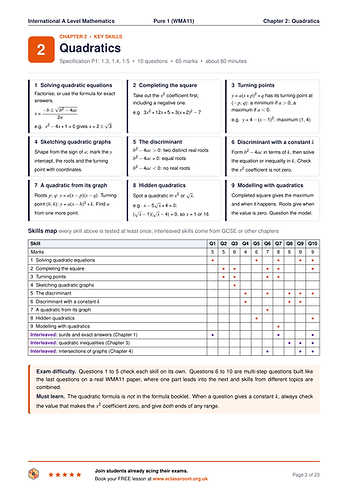
The ten questions build from solving and completing the square, including a negative x² coefficient, to sketching, modelling a thrown stone, and discriminant problems in which the x² coefficient itself contains k. The final question treats a quartic as a quadratic in x² and asks for the exact range of values giving four real solutions, with both a lower and an upper limit.
The ten questions
- Q1 (5 marks): solve 3x² + 10x − 8 = 0, then 2x² − 6x + 1 = 0 with exact surd answers.
- Q2 (5 marks): complete the square on 2x² − 12x + 23, then use it for a minimum value and the maximum of its reciprocal.
- Q3 (6 marks): write 5 + 4x − x² in the form p − (x+q)² and sketch the curve with its turning point and axis crossings.
- Q4 (4 marks): find the values of k that give 3x² + kx + 12 = 0 equal roots, and the root in each case.
- Q5 (6 marks): solve a quartic in x² and an equation in √x by spotting the hidden quadratic.
- Q6 (7 marks): find a quadratic from its graph, complete the square, read off the maximum, then find when f(x) = k has two roots.
- Q7 (8 marks): a stone thrown from a platform: the maximum height, when it lands, and a limitation of the model.
- Q8 (6 marks): show an inequality in k for (k+3)x² + 6x + k = 5 to have two distinct roots, then solve it.
- Q9 (9 marks): two parabolas that meet at exactly one point: the values of k, the meeting point, and when they never meet.
- Q10 (9 marks): complete the square on a quartic, solve f(x) = 16 in surds, and find every A giving four real solutions.
Key skills tested
Solving quadratic equations. Factorise when you can; otherwise use the quadratic formula for exact answers. For example, x² − 4x + 1 = 0 gives x = 2 ± √3.
Completing the square. Take out the x² coefficient first, even when it is negative. For example, 3x² + 12x + 5 = 3(x+2)² − 7.
Turning points. y = a(x+p)² + q has its turning point at (−p, q): a minimum when a is positive and a maximum when a is negative. For example, y = 4 − (x−1)² has a maximum at (1, 4).
Sketching quadratic graphs. The sign of a gives the shape. Label the y intercept, the roots and the turning point with their coordinates.
The discriminant. b² − 4ac is positive for two distinct real roots, zero for equal roots and negative for no real roots.
Discriminant with a constant k. Write b² − 4ac in terms of k, then solve the equation or inequality in k. Check which value of k would make the x² coefficient zero.
A quadratic from its graph. Roots p and q give y = a(x−p)(x−q); a turning point (h, k) gives y = a(x−h)² + k. Use one more point to find a.
Hidden quadratics. Look for a quadratic in x² or in √x. For example, x − 5√x + 4 = 0 factorises as (√x−1)(√x−4) = 0, so x = 1 or 16.
Modelling with quadratics. The completed square gives the maximum value and when it happens; the roots give when the quantity is zero. Then question whether the model is realistic.
Worked example
Question 1 from this chapter. (a) Solve 3x² + 10x − 8 = 0. (b) Solve 2x² − 6x + 1 = 0, giving your answers in the form (a ± √b)/c.
(a) Factorise: (3x−2)(x+4) = 0, so x = 2/3 or x = −4.
(b) This does not factorise, so use the formula with a = 2, b = −6 and c = 1. The discriminant is 36 − 8 = 28, so x = (6 ± √28)/4. Since √28 = 2√7, this simplifies to x = (3 ± √7)/2.
The question warns that calculator solutions are not acceptable, so decimals with no working would score nothing. Simplifying √28 is a separate mark in the scheme.

Seen on real papers
Every question in our booklets is original. These are the recent papers where each question type has appeared.
- June 2023, Q3, and January 2025, Q9: completing the square, including a negative x² coefficient, then the turning point, as in Q2, Q3 and Q6.
- January 2023, Q8(c), and October 2024, Q4(a): writing a quadratic from its graph, as in Q6.
- January 2023, Q4: a discriminant inequality where k also multiplies x², the idea behind Q8.
- June 2024, Q4: two curves that touch, solved with the discriminant and then the touching point, as in Q9.
- June 2024, Q8(c): a quartic equal to a constant A, needing a range for A, as in Q10(d).
Where marks are lost
- The missing lower limit. In January 2023 the most common error on the discriminant question was leaving out 0 < k, the value where the x² term vanishes. In June 2024 very few gave the lower limit for A.
- Dropping the constant a. When a quadratic is read from a graph, writing (x−4)(x−10) instead of A(x−4)(x−10) loses most of the marks, a slip noted in January 2023 and again in October 2024.
- Negative x² coefficients. In January 2025, marks were lost completing the square on a quadratic with a negative x² term. Take out the negative factor before anything else.
- Not using the completed square. Some students found the turning point by another method when the completed square from the previous part gave it straight away.
Common questions
Is the quadratic formula in the formula booklet?
No. It has to be learned, along with the conditions on the discriminant.
When do I use the discriminant?
Whenever a question asks about the number of roots, equal roots, or a line or curve that touches, meets or misses another curve.
Why does k = −3 matter in Q8?
At k = −3 the x² term disappears and the equation is no longer a quadratic, so that value has to be checked separately before giving the final range.
Where this chapter leads
- Pure 1 Chapter 3: Equations and Inequalities: quadratic inequalities and regions.
- Pure 1 Chapter 4: Graphs and Transformations: where curves meet, and how many times.
- Pure 1 Chapter 8: Differentiation: a tangent of given gradient that leads to a quadratic in x².
- Pure 2 Chapter 2: Coordinate Geometry: the discriminant decides whether a line meets a circle.